Gaussian splats have multiple applications in M&E, but lately we are seeing more industries joining the 3DGS revolution with Volinga. Casepak, a complex industrial recycling facility, required a highly accurate digital twin to support training, maintenance, and operational planning. Traditional methods fell short of the required millimetre precision and real-time usability. That’s where UFX, a 3D and digital production team, stepped in.
By combining advanced capture techniques with Gaussian Splatting and deploying through Unreal Engine, the project transformed over 200,000 images into a fully interactive 3D environment. At the core of this transformation was Volinga, bridging the gap between raw spatial data and a usable, real-time application.
The Challenge
Creating a digital twin of Casepak introduced several technical barriers:
- Scale & Complexity: Intricate machinery layouts and massive datasets (~200,000 images)
- Accuracy Requirements: Sub-millimetre precision for engineering use cases
- Processing Bottlenecks: Long reconstruction times and unstable alignments
- Workflow Limitations: Traditional photogrammetry pipelines could not support real-time deployment
Without a real-time rendering layer, the project risked remaining a static dataset rather than a functional tool.
Why Gaussian Splatting
Gaussian Splatting was selected for its ability to deliver:
- Real-Time Rendering: No baking or heavy mesh optimization required
- High Visual Fidelity: True depth, parallax, and spatial accuracy
- Scalability: Continuous updates and expansion without rebuilding
However, Gaussian splats alone were not enough. They required a system capable of making them usable in production
Volinga: The Enabling Layer
Volinga played a critical role in transforming raw data into an interactive experience.
1. Real-Time Performance at Scale
Volinga enabled smooth rendering of massive datasets at 60+ FPS in 4K, making real-time interaction possible even in a dense industrial environment.
2. Data Optimization & Conversion
Volinga optimized the project’s massive Gaussian splat datasets by converting raw PLY files into efficient NVOL assets, significantly reducing computational overhead for smooth real-time playback. This enabled the team to manage and render terabyte-scale datasets efficiently while maintaining high-performance interactive visualization inside Unreal Engine.
3. Seamless Unreal Engine Integration
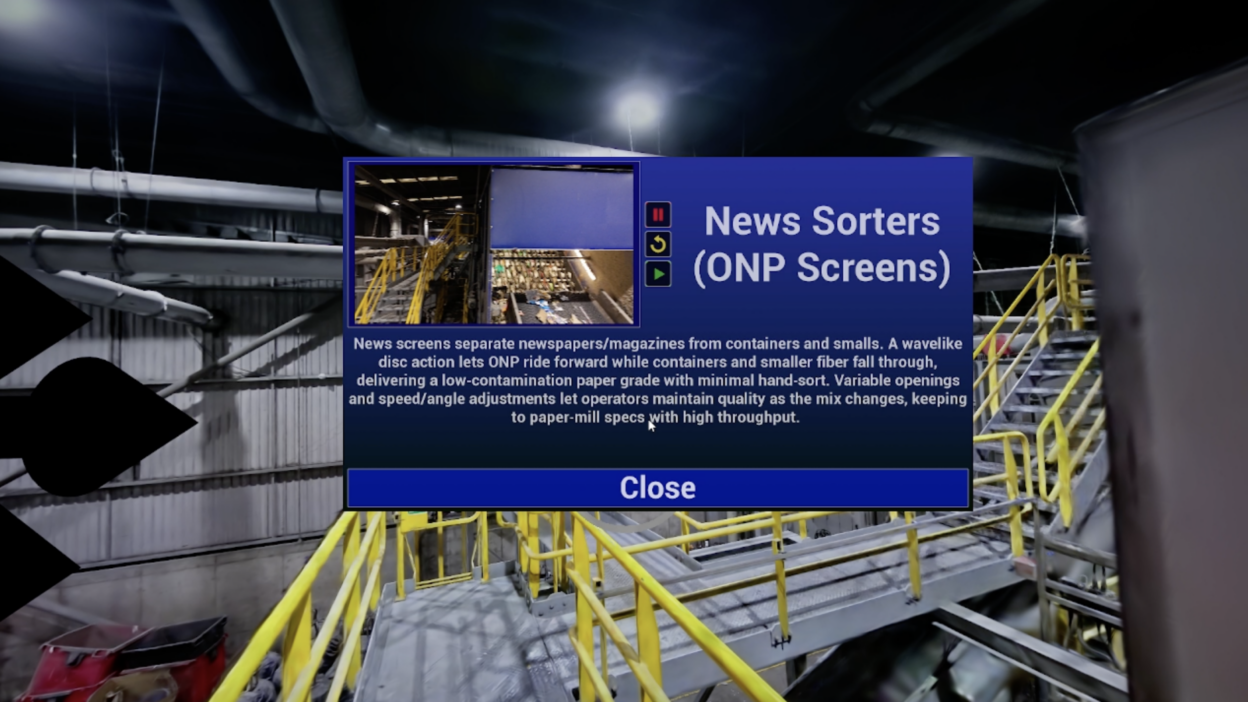
Volinga’s native integration with Unreal Engine enabled immediate deployment of the Casepak environment into a fully interactive real-time experience, providing complete control over navigation, camera movement, and user interaction while seamlessly supporting UI systems, hotspots, and embedded media layers. 4. Unlocking Interactivity
The Casepak facility evolved from a static walkthrough into a fully navigable real-time 3D environment, enriched with dynamic data overlays displaying equipment specifications, maintenance schedules, and operational insights directly within the immersive experience.
https://cms.volinga.ai/wp-content/uploads/2026/05/Casepak_Walkthru_2.mp4
Pipeline Overview
- Capture: XGRIDS Portal Cam + hybrid capture system
- Processing: LCC transforms imagery into Gaussian splats
- Volinga: Converts and optimizes data into real-time-ready assets
- Deployment: Unreal Engine for interaction and visualization
- Delivery: Standalone application deployable across devices
Workflow Breakthrough
A critical pivot to the XGRIDS Portal Cam introduced structured data capture, but it was Volinga that made the dataset usable.
Without Volinga:
- The project would remain a heavy, unmanageable dataset
- Real-time interaction would not be possible
- Deployment into production workflows would fail
With Volinga:
- Data became interactive, scalable, and deployable
- Processing pipelines became efficient and predictable
- The environment evolved into a living digital asset
Key Takeaway
Volinga is the bridge between capture and experience. It transforms complex spatial data into a usable product, enabling real-time interaction, scalability, and deployment in environments where traditional workflows fail.
“Volinga is the enabling layer that turns raw spatial data into a usable product. Without it, this project would remain a dataset, not an experience.”
– Keshava Walcott, Technical Director & Founder, UFX
Ready to bring 3DGS into your projects?
Discover how Volinga is helping productions bring real-world environments into industrial workflows.
Credits
Production Team: UFX
Client: Casepak
Unreal Engineer: Gourav Kharki
Capture Technician: Ajay Singh